

























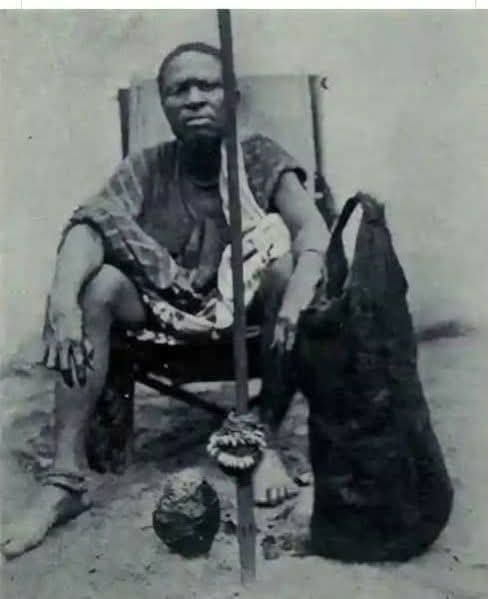


Long before the British invaded Igboland, there lived a master blacksmith from Oka, working in the town of Aguleri-Otu.


His name was Emenogha.
He was a specialist in making hoes, which meant that he must work at nights to avoid the intolerable heat of the day.

Emenogha used to begin smithing around 1.a.m.
The people of Aguleri-Otu had a powerful and dreaded masquerade called Ayaka that came out only in the night.

Ayaka, must see no light; and it did not like smithing.
So, whenever it was about to come out, Oka smiths were warned not to work.
On the occasion of this story the warning went out as usual – Ayaka was coming out, no smithing!
On that night, Emenogha went into his smithy, lighted the fire, and told his apprentice to work the bellows.
The Ogene of the Masquerade began to sound.

The Masquerade said to its followers, “I hear the sound of smithing”. They told it that Emenogha had been warned, but had insisted on working.
Ayaka said, go and tell Emenogha to stop work, and get inside his house.
To those who came to give him Ayaka’s message Emenogha said, “Onwu anara egbu onye na achu nkie, nkem ka nna achu“ (Death does not kill a man who is fighting for his daily bread, I am fighting for mine).
Ayaka took this as a challenge. It specially prepared for the outing, and hung all its charms around its body. It then stepped out, at the ogene sound, and the followers sang its praises.
Near Emenogha’s workshop the Masquerade began to dance about, shouting defiance.
Before then Emenogha had warned his apprentice never to show fear. He put an “aba” (a charm) under the boy’s seat and told him to sit on it, which the boy did. It gave the boy courage.
When the masquerade stopped in front of the smithy, Emenogha gave it the Oka blacksmith’s salute: he struck his anvil with his Otutu (hammer) – tam!tam!tam! tra-ra-ra-ra-ra-ra, three sharp blows and the fourth trailing off to an end. It was called “mbuche otutu”.

The Masquerade said, “Emenogha, nwa-Oka, my masquerade greets you!
Emenogha replied “Nnekwu mmonwu” (great spirit).
The masquerade asked, “Emenogha, nwa-Oka do you know me? God forbid! Emenogha replied, “I do not know you. The dead and the living do not mingle”.
The masquerade danced away, and then came back.
The masquerade asked “Emenogha, nwa-oka, are you not afraid of me?
Emenogha replied, “I am not afraid”, and he went on working, hammering the red-hot iron and making the sparks to fly.
The Masquerade stood for some time with its head to one side, listening to the music of its ogene, and the chants of its followers telling it that it was above all masquerades,
and the most powerful of them all. Then, with a spring, the Masquerade rushed into the smithy, and held Emenogha’s right hand as he raised it to strike the anvil.
Emenogha left the hammer in the grasp of the Masquerade.
The masquerade stood rooted to the floor. It could not move.
Calmly, Emenogha took out his snuff-box and leisurely took a pinch of snuff, and inhaled deeply.He courteously offered the snuff-box to the Masquerade, which paid no attention to him. Both continued to stare at each other for a long time.
The followers of the Masquerade began to feel uneasy, and they intensified their dancing outside calling on the Masquerade with their ogene to come out. But the
Masquerade could not move.
Then the followers began to throw their own charms about, but none had any effect. The masquerade stood where it stood.
Lastly, they were reduced to begging. They appealed to Emenogha to release their Masquerade. They reminded him that it would be a tragedy if the light of day should meet it there.
Emenogha said, “Egbe bel ugo bel” (live and let live).
He then gave his conditions for the atonement for the violation of the sanctity of an Oka man’s smithery. The followers of Ayaka were too happy to comply.
Emenogha then made a sign to his apprentice, and the boy got up from his seat.
Immediately, the hammer the masquerade was holding dropped to the floor. The masquerade bounded out of the workshop, as if it had been shot from a catapult!!
Outside the smithy, the Masquerade turned and cried out: “Emenegha now listen to mine: ‘Igabu ejeghejeghe elugh uno’! (You will be a wanderer on the face of the earth; you will never see Oka again). It then danced off with its chanting followers.
And so it happened, according to the story, that year, and every year following, when Emenogha prepared to go home, he would stop mid-way to Oka and say “Oh! I have forgotten such-and-such in my workshop “then, he would turn back to Aguleri-Otu, and not go home again that year.
The wife bore him a son, and he called the son “Eluomuno” (I have reached home), but still he did not reach home.
At last a group of Oka people waited for him on the way, and when he wanted to turn back they seized him physically, and brought him home to Oka. But he did not stay long; he left after a few days, and returned to Aguleri-Otu. He died in the foreign land, and was buried there. But his descendants returned to Oka.
Emenogha was a typical Oka man; he was brave, fearless and self-reliant.
If you’ve read this far, kindly like and follow this page for more pieces of valuable history like this.
Ika Onye Ọka anona, Nyavbulu ishi.
Source:
‘The Awka People’ by Ozo(Barr.)Amanke Okafor











 EduTimes Africa, a product of Education Times Africa, is a magazine publication that aims to lend its support to close the yawning gap in Africa's educational development.