













































President Bola Ahmed Tinubu has called for a major reform of the United Nations Security Council, demanding at least two permanent seats for Africa with full rights and responsibilities, including veto power for as long as the veto remains part of the Council’s structure.
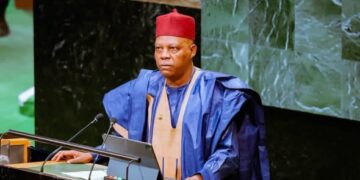
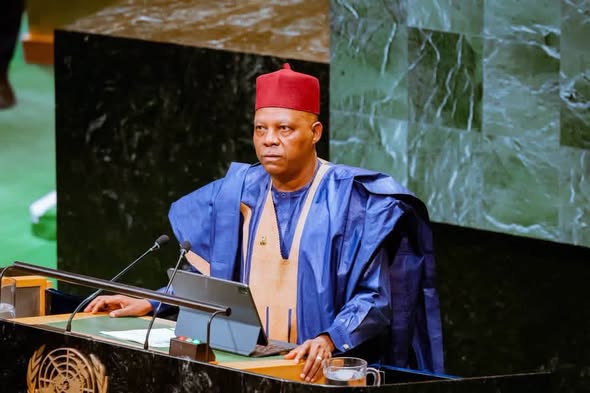
Tinubu made the demand in Nigeria’s national statement at the 81st Session of the United Nations General Assembly in New York. Vice President Kashim Shettima represented the President at the high-level session and delivered Nigeria’s national statement on his behalf.

Tinubu said the current structure of the United Nations no longer reflects the realities of the world in 2026, arguing that Africa could no longer remain excluded from permanent membership of the Security Council despite its significant contributions to international peace and security.
“The reform of this institution must begin with the reconstitution of the Security Council, for the world of 2026 cannot remain captive to the distribution of power in 1945,” the President said in the statement delivered by Shettima.

He said Africa could not continue to contribute to the Council’s agenda while remaining absent from its permanent membership.
“Africa cannot continue to fill the Council’s agenda while remaining absent from its permanent membership,” Tinubu said.
Nigeria is demanding at least two permanent seats for Africa, with the full rights and responsibilities attached to permanent membership, including veto power for as long as the veto remains in existence.
The country is also seeking five non-permanent seats for Africa, in line with the African Union’s Ezulwini Consensus and Sirte Declaration, which set out the continent’s common position on reform of the UN Security Council.
The UN Security Council currently has 15 members, comprising five permanent members – China, France, Russia, the United Kingdom and the United States – and 10 non-permanent members elected for two-year terms. Africa currently has no permanent seat on the Council.
Tinubu said Nigeria remained prepared to play a greater role in maintaining international peace and security, citing the country’s contributions to peacekeeping, mediation and conflict resolution across Africa.
He referenced Nigeria’s involvement in peace and security efforts in Liberia, Sierra Leone, Darfur, Mali and The Gambia, as well as its role through regional and continental institutions.

The President also called for stronger international cooperation in addressing conflicts, humanitarian crises and threats to global peace, stressing the need to uphold international law and protect civilians.
On economic development, Tinubu called for reforms to the international financial system and greater access to affordable financing for developing countries.

He also highlighted the African Continental Free Trade Area as an important platform for increasing intra-African trade, strengthening regional value chains and supporting industrialisation across the continent.
Tinubu further called for greater investment in Africa’s human capital, infrastructure, technology and productive capacity, arguing that the continent should move beyond the export of raw materials and increase value addition.
On climate change, the President reaffirmed Nigeria’s commitment to achieving net-zero emissions by 2060 while maintaining that developing countries must have the opportunity to expand energy access, reduce poverty and pursue economic development.
Nigeria’s demand for permanent African representation on the Security Council forms part of the African Union’s longstanding campaign for reform of the global body’s decision-making structure.
The Ezulwini Consensus and Sirte Declaration call for two permanent African seats and five non-permanent seats, with Africa seeking the same rights and privileges as other permanent members, including veto power if the veto remains part of the Council’s system.
The demand at the 81st UN General Assembly therefore places Nigeria’s position within the broader African campaign for a greater role in decisions concerning international peace and security.




 EduTimes Africa, a product of Education Times Africa, is a magazine publication that aims to lend its support to close the yawning gap in Africa's educational development.