

















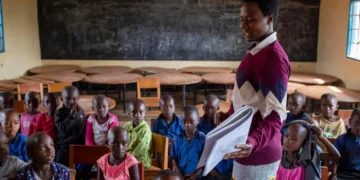





































Abia State Governor, Alex Otti, has said concerns about using indigenous languages for early childhood education in Nigeria may be overstated, arguing that countries such as China, India and South Korea have successfully used local languages in schools without hindering educational or national development.



Otti made the remarks at the 24th Annual Symposium of the Fafunwa Educational Foundation (FEF) and the 19th Post-Doctoral Awards in Education held at the Muson Centre, Onikan, Lagos.

The event, themed “What Does the Research Say? Mother Tongue Instruction and the Future of Early Education in Nigeria,” brought together educators, policymakers, government officials, parents and media practitioners to discuss research findings on the impact of mother tongue instruction on learning outcomes.
The governor acknowledged existing concerns about the approach but urged stakeholders to draw lessons from countries where indigenous languages remain central to early education.

“The fears, I have to admit, are real, but we may also have to look at a few countries where early education is driven by indigenous languages, including South Korea, India and China. In doing so, we may learn a few lessons from the success they have achieved over the years,” Otti said.
He noted that while opinions may differ on the issue, research findings should not be dismissed simply because they challenge existing beliefs.
According to him, studies suggesting that children learn better when taught in their indigenous languages should encourage policymakers to address implementation challenges rather than abandon the idea altogether.
“My position would be that if children and professionals in China suffer no disadvantage from learning in Mandarin, just like their counterparts in India or South Korea who started their learning in indigenous languages, then the fears against the use of indigenous languages for early-stage education in this part of the world may be exaggerated at best,” he stated.
Otti also paid tribute to the late Professor Babatunde Fafunwa, Nigeria’s first Professor of Education and former Minister of Education, describing him as a visionary whose ideas continue to influence educational development in the country.
The governor’s remarks come months after the Federal Government reversed the 2022 National Language Policy, which had recommended the use of mother tongue or the language of the immediate community as the medium of instruction from early childhood to primary six.
Education Minister, Dr. Tunji Alausa, announced in November 2025 that English would remain the language of instruction from primary school through tertiary education, citing Nigeria’s linguistic diversity and the challenge of teaching in local languages while conducting examinations in English.
Also speaking at the symposium, keynote speaker and University of Ibadan professor, Francis Egbokhare, said the major challenge facing mother tongue instruction in Nigeria was not the concept itself but inadequate preparation for its implementation.
He identified teacher training, instructional materials and assessment methods as key areas requiring attention.
According to Egbokhare, research has consistently shown that children benefit academically when taught in their indigenous languages during their formative years.

He, however, raised concerns about practical issues such as determining the appropriate language of instruction in multilingual settings and the availability of textbooks for subjects like Mathematics, Science and Technology in indigenous languages.

Permanent Secretary of the Lagos State Ministry of Tertiary Education, Adeniran Kasali, also supported the use of mother tongue in early education, stressing that no nation can achieve meaningful development without promoting its local content.
Similarly, guest speaker Prof. Angelina Kioko of the United States International University, Nairobi, observed that code-switching remains common in many African classrooms even where mother tongue policies exist.
She identified inadequate teacher capacity, lack of learning materials in indigenous languages and poor policy implementation as major obstacles to effective mother tongue instruction across the continent.












 EduTimes Africa, a product of Education Times Africa, is a magazine publication that aims to lend its support to close the yawning gap in Africa's educational development.