



























For years, concerns have persisted over the gap between university classrooms and the realities of the labour market, with employers frequently questioning graduate preparedness and the practical impact of academic research. Now, the National Universities Commission says closer collaboration between universities, industry and government is critical to changing that narrative.



The Executive Secretary of the National Universities Commission, Abdullahi Ribadu, has called for stronger partnerships among universities, industry, government and international stakeholders to reposition higher education as a driver of innovation, entrepreneurship and national development.

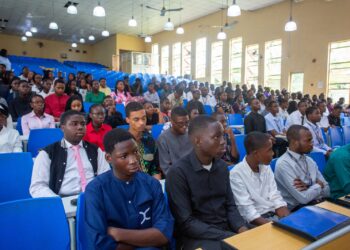
Ribadu made the call on Tuesday in Abuja during the International Conference on Academic Entrepreneurship, Knowledge and Technology Transfer in Nigerian Universities.
The conference brought together participants from universities, research institutions, development agencies and international partners, including representatives of University of Koblenz and University of Erfurt.

Represented by the Director of Research, Information and Technology, Lawal Farouk, Ribadu said universities around the world are increasingly expected to move beyond their traditional responsibilities of teaching and research.
“This conference comes at an important time for university education, both internationally and within Nigeria,” he said.
“Across the world, universities are increasingly being called upon to move beyond their traditional roles of teaching and research and become centres of creativity, enterprise and societal transformation.”
He said the commission remains committed to reforms that will equip graduates with the skills required to thrive in a rapidly changing global economy.
According to him, the vision informed the development of the Core Curriculum and Minimum Academic Standards, which places emphasis on competency-based and learner-centred education.
“The CCMAS framework seeks to equip students not only with disciplinary knowledge, but also with entrepreneurial skills, digital competencies, critical thinking, and the adaptability required in today’s workplace,” he said.
Ribadu noted that universities must increasingly be judged by their ability to transform research outcomes into practical solutions, businesses and societal benefits.
“Increasingly, the success of modern universities will not be measured only by the quality of teaching and research. It will also be measured by their ability to convert ideas into innovation, innovation into enterprise, and research into societal impact,” he stated.
He stressed that achieving this goal would require stronger partnerships among academia, industry, government and investors, as well as institutional cultures that encourage innovation.

Ribadu also described collaboration with German universities as an important step toward strengthening innovation ecosystems and enhancing global competitiveness.
“Our partnership with the University of Koblenz and the University of Erfurt demonstrates the value of partnerships in advancing these goals,” he said.
Delivering the keynote address, Harald Korflesch of the University of Koblenz called for greater professionalisation of academic entrepreneurship and stronger efforts to commercialise research outputs.

He urged universities to embrace what he described as the “third mission” of higher education — translating research into societal impact.
Korflesch observed that while many universities operate entrepreneurship programmes, incubation hubs and innovation initiatives, the outcomes often fall short of expectations.
“We are very good at research and innovation, but we are not able to commercialise enough. We are not able to make much more out of the research,” he said.
He advocated entrepreneurship education rooted in real-world projects, stronger industry partnerships and structured pathways for transforming research into viable businesses through proof-of-concept funding and spin-off development.
Korflesch also highlighted the importance of alumni and diaspora networks in building sustainable innovation ecosystems.
He challenged universities to focus not merely on introducing entrepreneurship programmes but on improving their effectiveness and impact.
“It’s not about shall we do it, it is set, but how and how well we can do it,” he said.
The conference comes amid ongoing efforts to improve graduate employability and strengthen links between academic research and industry needs, issues that have remained central to debates on higher education reform in Nigeria.













 EduTimes Africa, a product of Education Times Africa, is a magazine publication that aims to lend its support to close the yawning gap in Africa's educational development.