

























What happens when fashion, manufacturing and job creation meet in one space?
In Kwara, state officials and private-sector players believe the answer could lie inside a garment factory expected to support thousands of workers while creating opportunities for young creatives, tailors and fashion entrepreneurs.

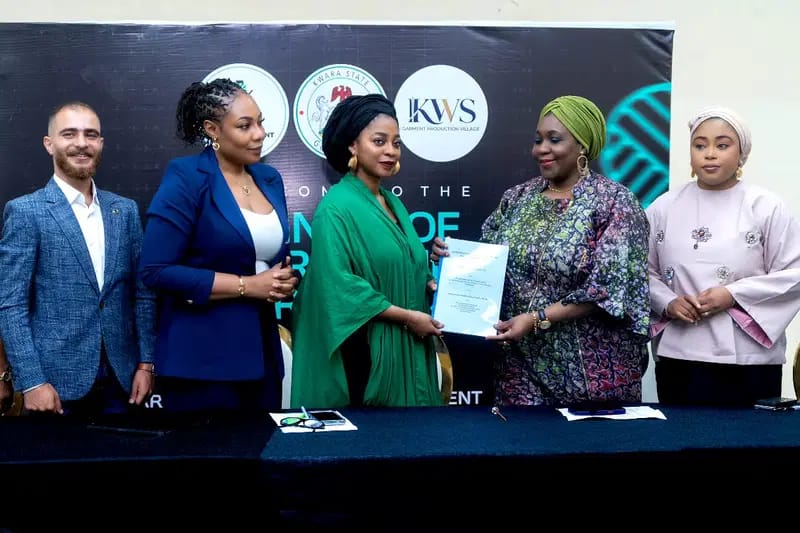
The Kwara Garment Factory has officially signed a management and operation agreement with KWS Garment Production Village, led by Folake Akindele, founder and CEO of tiffanyamber.com and one of Africa’s leading fashion figures over the last three decades.
The agreement, signed during a ceremony held at the Kwara Garment Factory in Ilorin on May 12, 2026, marks a major phase in the state’s industrialisation agenda under Governor AbdulRahman AbdulRazaq.

The process was handled by Managing Director of the Kwara Garment Factory, Bukola Adedeji, in the presence of Commissioner for Business, Innovation and Technology, Damilola Yusuf Adelodun.
Designed for large-scale apparel production, the facility is expected to serve multiple sectors, including fashion, sportswear, hospitality, institutional agencies and corporate organisations.

The factory is also built to support up to 4,000 workers across its production ecosystem, positioning it among Africa’s largest industrial garment manufacturing hubs.
According to the management of KWS Garment Production Village, about 80 per cent of the production workforce are women — a move aimed at strengthening women’s economic participation in industry.
The facility is also powered by an on-site solar plant, making sustainability part of its operational structure.

Speaking during the handover ceremony, Akindele described the development as a milestone beyond fashion.
“After 28 years in the Nigerian fashion industry, moments like this remind me why I started this journey. What began with passion and resilience has evolved into something much bigger than fashion itself. Today is about industry, infrastructure, manufacturing, job creation, and legacy,” she said.
Akindele said unreliable manufacturing infrastructure has remained one of the biggest barriers facing Nigeria’s fashion and creative industries.
“This factory represents possibility. It represents scale. It represents structure. It is about building systems that allow Nigerian businesses, creative, institutional, and corporate alike, to produce competitively, efficiently, and proudly within Nigeria. If you have been going outside Africa to manufacture and access world-class quality, you can get that same standard here,” she added.
Speaking on behalf of the Kwara State Government, Adelodun described the factory as part of a long-term plan for industrial growth.
“The Kwara State Garment Factory has always represented more than a building or a set of machines. It represents a vision; His Excellency’s vision of an industrialised Kwara, where our youths do not just consume but produce, where the state’s resources translate into real livelihoods and lasting economic activity.”
The long-term vision for KWS Garment Production Village also includes expansion into textile manufacturing, with the African Continental Free Trade Area expected to create opportunities for African-made apparel to move more freely across the continent.
Credit: Vanguard














 EduTimes Africa, a product of Education Times Africa, is a magazine publication that aims to lend its support to close the yawning gap in Africa's educational development.